Here We Go Again Female Singer
| "Here We Get Again" | ||||
|---|---|---|---|---|
 "Here We Go Once more" 7-inch single cover art | ||||
| Single by Ray Charles | ||||
| from the album Ray Charles Invites Y'all to Listen | ||||
| B-side | "Somebody Ought to Write a Book Nearly Information technology" | |||
| Released | 1967 | |||
| Recorded | RPM International Studio (Los Angeles) | |||
| Genre | Rhythm and dejection | |||
| Length | 3:18 | |||
| Characterization | ABC Records/Tangerine Records | |||
| Songwriter(s) | Don Lanier, Red Steagall | |||
| Producer(s) | Joe Adams | |||
| Ray Charles singles chronology | ||||
| ||||
"Here Nosotros Go Again" is a state music standard written past Don Lanier and Cherry Steagall that start became notable equally a rhythm and blues single past Ray Charles from his 1967 album Ray Charles Invites You to Listen. Information technology was record producer by Joe Adams for ABC Records/Tangerine Records. To date, this version of the song has been the biggest commercial success, spending twelve sequent weeks on the Us Billboard Hot 100 chart, peaking at number fifteen.
The virtually notable cover version is a duet past Charles and Norah Jones, which appeared on the 2004 anthology Genius Loves Company. This version has been the biggest critical success. Afterwards Genius Loves Company was released, "Here We Go Again" earned Grammy Awards for Tape of the Year and Best Pop Collaboration at the 47th Grammy Awards in February 2005, posthumously for Charles, who died before the album's release. Some other notable version by Nancy Sinatra charted for v weeks in 1969. Johnny Duncan charted the song on Billboard 's Hot Country Songs chart for v weeks in 1972, while Roy Clark did so for seven weeks in 1982.
The vocal has been covered in a wide diversity of musical genres. In total, five different versions have been listed on the music charts. Although its two most successful versions have been rhythm and blues recordings, many of its other notable covers were featured on country music albums. "Here We Go Again" was get-go covered in an instrumental jazz format, and many of the more than recent covers take been sung every bit duets, such as 1 with Willie Nelson and Norah Jones with Wynton Marsalis accompanying. The song was released on their 2011 tribute album Here We Get Once again: Celebrating the Genius of Ray Charles. The song lent its name to Red Steagall's 2007 album as well. Cover versions have appeared on compilation albums by a number of artists, even some who did not release "Hither We Go Again" as a unmarried.
Original version [edit]
In November 1959, after twelve years as a professional musician, Ray Charles signed with ABC Records, following the expiration of his Atlantic Records contract.[1] Co-ordinate to Will Friedwald in A Biographical Guide to the Smashing Jazz and Pop Singers, "His first four ABC albums were all primarily devoted to standards..."[two] In the 1960s, he experienced crossover success with both rhythm and blues and land music. Because Charles was signed to ABC as a rhythm and blues singer, he decided to wait until his contract was upwardly for its iii-twelvemonth renewal before experimenting with country music, although he wanted to do then sooner. With the help of ABC executive Sid Feller, he gathered a set of country songs to record, despite the wishes of ABC.[3] The release of his 1962 land albums Modern Sounds in Land and Western Music and its follow-up Modernistic Sounds in Land and Western Music, Vol. 2 broadened the entreatment of his music to the mainstream. At this betoken, Charles began to appeal more to a white audition.[4] In 1962 he founded his own record characterization, Tangerine Records, which ABC-Paramount promoted and distributed.[5] [half-dozen]
"Here We Go Over again" was recorded during a phase in Charles' career when he was focused on performing country music.[7] Thus, "Here We Go Again" was a country music song released by the Tangerine characterization ABC-Paramount, just performed in Charles' rhythm and blues style. Yet, his works did not bear the Tangerine label until 1968.[8] Feller left ABC in 1965,[9] but he returned to arrange Charles' 1967 anthology, Ray Charles Invites You to Listen.[10] Joe Adams produced and engineered the album, which included "Here We Become Again".[x]
First released by Charles in 1967, "Hither Nosotros Go Again" was written by Lanier and Steagall and published by the Dirk Music Visitor.[11] Charles recorded it at RPM International Studios, Los Angeles,[12] [13] and the song was listed every bit the sixth of x tracks on Ray Charles Invites Yous to Listen.[14] [15] [xvi] Starting in 1987, it was included in numerous greatest hits and compilation albums.[17] When Modern Sounds in Country and Western Music was reissued in 1988, the song was added as a bonus track.[12] [13] It was also included on the 1988 anthology Ray Charles Anthology.[18]
Limerick [edit]
Steagall endured polio every bit a teen and learned how to play the guitar and mandolin during his recuperation.[nineteen] This action helped him regain the use of his left arm and manus.[20] When he enrolled at Westward Texas Land University, he formed his starting time country band.[19] Don Lanier formed a group by the name of The Rhythm Orchids along with Buddy Knox and Jimmy Bowen.[21] He was hired equally a soil pharmacist but played weekends at country dances. Later on he quit his professional part, he formed a ring that became popular in the Rocky Mountain ski-resort clubs.[22] He moved to Los Angeles in 1965 and embarked on folk club performing and songwriting.[23] He wrote for 2 music publishers, Tree and Combine, earlier signing with Capitol Records.[22] Eventually, Steagall joined Lanier and Bowen. Steagall and Lanier co-wrote "Hither We Go Once more".[21] Steagall's starting time suspension came when Charles covered "Here Nosotros Get Over again".[xix] Steagall says that the song "came about in a very unusual manner and very quickly".[21] One source even claims that Steagall did not come to Hollywood until after Charles recorded the vocal.[24]
According to the canvass music published by Dirk Music, "Here We Go Once more" is ready in 12/viii time with a tedious shuffle tempo of threescore-9 beats per infinitesimal. The song is written in the cardinal of B ♭ major.[25] It is primarily a country song,[26] but contains gospel influences.[27] According to Matthew Greenwald of Allmusic, "'Here We Become Over again' is a soulful carol in the Southern dejection tradition. Lyrically, it has a resignation and pain that makes the dejection, simply, what it is. The recording has a simple and sterling gospel arrangement and, in retrospect, is ane of Charles' finer attempts in the studio from the 1960s."[28]
Performance history [edit]
The playlist of the 1967 tour promoting Ray Charles Invites You lot to Mind is non readily available, only "Here We Go Again" was the best-charting vocal on the album (and probable on the playlist). Charles' bout began with a benefit concert on the USS Constellation, which was preparing to depart for the Vietnam War from San Diego Harbor. The tour, Charles' commencement since 1964, connected to Europe in mid-April where it visited the Royal Festival Hall, London and Salle Pleyel, Paris, likewise as Vienna. In May, the band played back in the United states at New York City's Carnegie Hall earlier returning to California. The tour received bad reviews from publications such as Jazz Periodical, Jazz Mag and the New York Post. Subsequently that summer, the band played Constitution Hall, Washington, D.C. In the fall, Charles had his first lucrative Nevada casino performances, which started with a three-calendar week run at Harrah'south Reno that was praised in Variety. The tour likewise had an extended autumn run at New York's Copacabana nightclub.[29]
Reception [edit]
Greenwald described the original version of "Here We Go Once again" as "Another excellent example of how Ray Charles was able to fuse blues and country".[28] In a review for the unmarried, a writer for Billboard magazine wrote that the song could easily exist a "blockbuster" for Charles.[26]
The original version debuted at number 79 on the Billboard Hot 100 chart in the May xx, 1967, outcome and number 48 on the US Billboard Hot Rhythm & Blues Singles top 50 nautical chart on June 10, 1967.[30] [31] For the weeks ending July fifteen, 22 and 29, the vocal spent three weeks at its superlative position of number fifteen on the Hot 100 chart.[32] [33] Information technology spent July 22 and 29 at its summit position of number 5 on the Hot Rhythm & Blues Singles chart.[34] [35] By Baronial 12, it barbarous out the Hot 100 chart, ending a 12-week run.[36] Information technology remained on the Hot Rhythm & Blues Singles chart for xiii weeks catastrophe on September 2.[37] [38] "Here We Get Once again" was Charles' terminal single to enter the pinnacle 20 of the Hot 100.[39] For the year 1967 the song finished at number lxxx on the US Billboard Twelvemonth-End Hot 100 chart and 33 on the Year-End Hot Rhythm & Blues Singles chart.[40]
Abroad, it debuted on the UK Singles Chart top forty at number 38 on July viii, 1967, which would be its summit.[41] It totalled iii non-consecutive weeks on the chart.[42] [43] In kingdom of the netherlands, "Hither We Become Again" appeared on the singles chart at number 10 on July 15, 1967, and later peaked at number three.[44]
According to Volition Friedwald, this song is an example of Charles vocalizing in what would unremarkably be a generally extraneous style for dramatic effect past using a different voice than he had ever previously exhibited. He sang "... not just using the squeak—using a whole new kind of squeak, in fact—for additional coloring on the sidelines, but making it the eye of the matter, literally squeaking out the words and notes in harmony with the Raelettes" (his background singers).[two]
Track listing [edit]
- 7-inch single [45]
- "Here We Go Again" – three:fourteen
- "Somebody Ought to Write a Book About It" – 3:02
According to Allmusic, the solo version is listed at lengths betwixt three:14 and 3:twenty on various albums.[17]
Credits [edit]
Charles is credited every bit vocaliser and pianist with unknown accompaniment. Feller is credited for having bundled and conducted the recording. This is one of two songs on the album ("Yesterday" being the other) that in addition to being listed as ABC-Par ABC595 is credited every bit Dunhill DZS036 [CD].[46] The individual song had a label number ABC/TRC 10938.[47] [48] "In the Heat of the Dark" too had a Dunhill credit but a different number for both Dunhill and ABC.[46]
Nancy Sinatra version [edit]
| "Here We Get Again" | ||||
|---|---|---|---|---|
 | ||||
| Unmarried by Nancy Sinatra | ||||
| from the anthology Nancy | ||||
| B-side | "Memories" | |||
| Released | 1969 | |||
| Genre | Country | |||
| Length | three:07 | |||
| Label | Reprise (#0821) | |||
| Songwriter(due south) | Don Lanier, Cherry Steagall | |||
| Producer(s) | Baton Foreign | |||
| Nancy Sinatra singles chronology | ||||
| ||||
Nancy Sinatra recorded a cover of the vocal for her 1969 album Nancy, which was her first album afterwards ending her business organisation relationship with producer Lee Hazlewood.[49] The cover, which according to programming guides had an piece of cake listening and country music appeal,[l] was produced past Billy Foreign.[51] [52] The B-side to the single, "Memories", was written past Strange along with Mac Davis.[52] [53] Billboard magazine staff reviewed the song favorably, stating that the cover was a "shine sing-a-long pop style".[52] They also commended Sinatra'southward singing, calling it a "fine" performance, noting that information technology would likely render her to the Billboard charts.[52] Sinatra's version was later remastered and reissued in 1996.[54]
Chart performance [edit]
Although CD Universe describes the vocal as a country music song,[49] it never charted on country music charts. For the calendar week ending May 17, 1969, the vocal was listed amid Us Billboard Bubbling Under Hot 100 Singles chart at number 106 and debuted on the United states Billboard Easy Listening Meridian twoscore chart at number 30.[55] [56] The following week it debuted on the US Billboard Hot 100 chart at number 98,[57] its apex for its two-calendar week stay.[58] The vocal then spent a total of two weeks on the Hot 100.[59] For the week ending June seven, the song spent a 2d consecutive week at its peak position of number 19 on the Easy Listening chart.[threescore] The song remained on the chart for five weeks until June fourteen, 1969.[61] [62] In Canada "Here We Get Once more" debuted at number 38 on the RPM Adult Contemporary chart (previously Young Adult Chart) on June two, 1969.[63] It peaked at number 21 for the week of June 16, 1969.[64] The song spent a full of v weeks on the nautical chart.[65] [66] According to Allmusic databases, 1969 was the final year in her career that Sinatra reached the Hot 100 chart (with "Here We Go Again", "God Knows I Dear You" and "Drummer Man").[67]
Track list [edit]
- seven-inch vinyl single [53]
- "Here We Go Again" – 3:07
- "Memories" – iii:40
According to Allmusic the original track was 3:09, but when it appeared on the 2006 compilation anthology Essential Nancy Sinatra, it was 3:11.[68] The single was initially released through Reprise Records. In a non-sectional licensing understanding, Reprise (function of Warner Music) gave RCA Records the rights to distribute the records of some of their artists including Sinatra and Dean Martin.[69] In 1971, Sinatra and Reprise parted ways, and then she signed a long-term contract with RCA Records.[70]
Credits [edit]
The post-obit musicians performed on this track:[51]
- B.J. Baker Singers (backup vocals)
- The Blossoms (backup vocals)
The following musicians performed on this album:[49]
- Al Casey (guitar)
- Jerry McGee (guitar)
- Red Rhodes (steel guitar)
- Sid Sharp (violin, strings)
- Jim Horn (flute)
- Roy Caton (trumpet)
- Don Randi (piano)
- Jerry Scheff (bass guitar)
- Ballad Kaye (bass guitar)
- Hal Blaine (drums)
Norah Jones and Ray Charles duet version [edit]
| "Here We Go Once more" | ||||
|---|---|---|---|---|
| Single by Ray Charles and Norah Jones | ||||
| from the anthology Genius Loves Visitor | ||||
| Released | January 31, 2005 | |||
| Recorded | RPM International Studio (Los Angeles) | |||
| Genre | Pop | |||
| Length | 3:59 | |||
| Label | Agree/Hear Music | |||
| Songwriter(s) | Don Lanier, Red Steagall | |||
| Producer(s) | John R. Burk | |||
| Ray Charles singles chronology | ||||
| ||||
| Norah Jones singles chronology | ||||
| ||||
In 2004, Charles re-recorded "Here We Go Again" every bit a duet with American vocaliser-songwriter Norah Jones, who grew upwardly listening to his music.[71] During Jones' Billboard interview for her 2010 collaboration album ...Featuring, which included her "Here We Get Again" duet, she said "I got a call from Ray asking if I'd be interested in singing on this duets tape. I got on the side by side airplane and I brought my mom. We went to his studio and did it live with the band. I sang information technology correct next to Ray, watching his oral cavity for the phrasing. He was very sugariness and put me at ease, which was keen because I was petrified walking in there."[72] She noted in 1 ...Featuring interview that the only part that was not done live was a pianoforte overlay that she added afterwards to complement Charles' keyboard. In the same interview, she noted that she had been given the opportunity to select a song from Charles' songbook to perform every bit a duet and felt that this 1 provided the best opportunity to harmonize rather than alternate vocal verses.[73] On the record, the two singers vocalize,[74] accompanied by Baton Preston on Hammond organ,[75] [76] who had at one time been the regular organist in Charles' band.[71]
Reception [edit]
As part of Charles' Grammy Award for Album of the Yr-winning Genius Loves Company, the vocal proved to be the most pop and critically acclaimed on the album. Although the song had its early detractors,[77] [78] it received by and large favorable reviews. Several reviewers noted the complementarity of Jones and Charles. The Daily Vault 'southward Jason Warburg described the vocal as a "jazzy, slinky pas de deux" in which Charles matches Jones note for notation."[79] JazzTimes' Christopher Loudon said Charles "blends seamlessly with Jones on a velvet-and-buckram" operation.[fourscore] The song was described by the Orlando Spotter 's Jim Abbott as a recreation of one of the gems from Charles' country music phase of the 1960s that produced the perfect "combination of voices and instruments" with Preston's accompanying function on Hammond B3.[7] As opposed to other tracks on the album, when Charles' vocalization was understated, this song was said to correspond his "indomitable spirit", while Jones performed as "an compassionate foil, [with] her warm, lazy vocals meshing convivially with his over a spare but funky organization".[71] Author Mike Evans wrote that "at that place's a mutual warmth of purpose in every breath [Charles and Jones] take" on the song.[75] Music Week staff noted the timeliness of the release with the biographical film Ray in theaters and described the song as soulful, that finely combines Charles' "deep, honeyed growl with Jones's lighter timber", while noting Preston for his "sweeping" organ work.[81]
The song received other specific forms of praise. Robert Christgau notes that Jones carried the song burden every bit did many of Charles's duet partners on the album.[82] United states Today 's Steve Jones said the song "strikes an easy groove".[76] PopMatters' Kevin Jagernauth says "Jones nicely compliments Charles on this beautiful opening track".[27] Preston'southward performance was favorably described by The Washington Post 's Richard Harrington as "smoky".[71] Critic Randy Lewis from the Chicago Tribune noted that the song's "countrified ache" represented that part of Charles' career.[83]
When the vocal was included on Jones' ...Featuring, which included three of her collaborations from Albums of the Year and several from albums that were nominees,[84] the song did not stand up out. Few of the reviews at Metacritic had substantive comments on the duet when included amidst her group of collaborations.[85] While reviewing ...Featuring, Jonathan Keefe of Slant Magazine wrote that the duet was a "more staid and less compelling recording" on the album.[86] Nonetheless, Allmusic staff noted that she worked comfortably with Charles and Chris Rizik of Soul Tracks said the rails was more just filler.[87] [88]
Awards and nominations [edit]
In Dec 2004, the Jones–Charles version of the song was nominated in two categories at the 47th Grammy Awards.[89] At the February thirteen, 2005 awards ceremony, the duet earned the honour for Tape of the Yr and Best Pop Collaboration with Vocals.[xc] It was the second Tape of the Yr winner not to make the Hot 100 (following "Walk On" in 2001 by U2).[91] The song won Record of the Year, but non Song of the Year. Record of the Year is awarded to the creative person(southward), producer(s), recording engineer(s) and/or mixer(s), if other than artist for newly recorded material. Vocal of the Yr is awarded to the songwriter(southward) of a new song or a vocal commencement achieving prominence during the eligibility year.[92] Steagall and Lanier are credited every bit the writers of this song from their work on its original version in 1967.[93] Thus, the song was not a new song.
Nautical chart performance [edit]
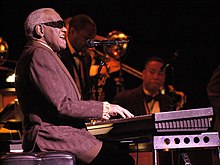
Charles in July 2003, less than 11 months before his 2004 expiry
For the week ending September 18, 2004, Genius Loves Visitor sold 202,000 copies, ranking second on the Us Billboard 200 chart and condign Charles' highest-charting album in over forty years. Digital singles sales saw 12 of the 13 tracks on the anthology brand the U.s.a. Billboard Hot Digital Tracks Peak fifty chart. "Here Nosotros Go Again" was the download sales leader amidst the anthology'southward songs that totaled 52,000 digital downloads.[94] [95] During the week the anthology was released, the song debuted on the US Billboard Hot Digital Tracks nautical chart at number 26.[96] "Here We Become Over again" fell out of the top 50 2 weeks later.[97] It was released as a single for digital download on January 31, 2005.[98] On May 22, 2019, the song was certified gold by the Recording Industry Association of America for shipments exceeding 500,000 units in the United States.
After the album earned eight Grammy Awards and the vocal won Record of the Year, sales picked upward and the album was re-promoted.[99] "Hither We Become Once more" entered the US Billboard Bubbling Under Hot 100 chart at number five in the issue dated (for the week ending) February 26, 2005.[100] The song charted for a week on both the Usa Billboard Hot Digital Songs summit 75 at number 73 and the U.s.a. Billboard Pop 100 at number 74 for the week ending March 5, 2005, merely withal did non brand the Hot 100,[101] ranking 113th earlier falling out of the nautical chart.[48] However, it ascended to its Bubbling Under Hot 100 chart peak position of number two for the week ending March 5, 2005.[102] A compact disc single of the song was released on April xix, 2005.[103]
In Austria, the duet debuted on the Ö3 Republic of austria Top xl chart at number 53 on March half-dozen, 2005, and peaked the following calendar week at number 52. It logged vi weeks on the chart.[104] "Here We Go Again" entered the French Singles Chart at number 54 on April ii, 2005 and peaked one week later at number 51. Information technology lasted 10 weeks on the summit 100 nautical chart.[105]
Rails listing [edit]
- CD single [103]
- "Here We Go Again" (Ray Charles and Norah Jones) – 3:59
- "Mary Ann" (Poncho Sanchez featuring Ray Charles) – 5:05
- "Interview With Norah Jones" – 1:35
Co-ordinate to Allmusic, the duet version was between 3:56 and 3:59 on various albums.[17]
Credits [edit]
|
|
The vocal was recorded at RPM International Studio (Los Angeles), mixed at Capitol Studios and mastered at the Mastering Lab.[106]
Country chart versions [edit]
Johnny Duncan charted a version of the song for Columbia Records that missed the Hot 100 chart. It debuted on the Hot Country Songs chart on September 30, 1972, peaking at number 66 and spending a total of five weeks on the chart.[107] The vocal also spent five weeks on the Cashbox Country Singles Chart, debuting on October 7, 1972, and peaking at number 61 three weeks afterward.[108]
In 1982, Roy Clark produced a version of the song on his Turned Loose album for Churchill Records that he performed on the November 6, 1982 (flavor xv, episode 9), episode of Hee Haw.[109] [110] It missed the Hot 100 chart, but it entered the Hot Country Songs chart for the week ending October xxx, 1982, at 88.[111] The song was one of only two mentioned in the October 30, 1982, Billboard album review and was described as "a solid country number".[112] The vocal peaked at number 65 in the week ending November 27 and remained in the chart for ii more weeks, making the total run seven weeks.[113] [114] The song as well spent seven weeks on the Cashbox Country Singles Nautical chart, debuting on November 6, 1982, and peaking at number 61 for 2 weeks (December 4 and 11).[115]
Other versions and uses [edit]
Billy Vaughn covered "Here We Go Again" on his 1967 Ode to Baton Joe instrumental anthology,[116] as did Dean Martin on his 1970 anthology My Woman, My Woman, My Wife.[117] Glen Campbell'southward version appeared on his 1971 album The Last Fourth dimension I Saw Her,[118] Eddy Arnold'due south on his 1972 album Lonely People,[119] and George Strait's on his 1992 album Holding My Ain.[120] Steagall performed it with Reba McEntire on his 2007 Here Nosotros Get Again album, simply she did not include it on her 2007 duets album Reba: Duets, which was released four weeks later.[121] [122] Their collaboration was favorably reviewed, and McEntire was said to reinvigorate this country standard by Nathalie Baret of ABQ Journal.[123] Martin'due south version was 3:07, and information technology after appeared on compilation albums, starting with the 1996 Dean Martin Aureate, Vol. 2. It has appeared on a scattering of other Martin compilation albums.[117] Campbell'due south version was only two:26.[118] Strait's version is 2:53 and appears later on his 2004 Greatest Collection at a 2:55 length.[120] Steagall's version with McEntire (who Steagall discovered at a 1974 county fair)[123] [124] is 3:ten.[125] R&B and boogie-woogie pianist and singer Fiddling Willie Littlefield recorded a version for his 1997 album The Red One.[126] [127] Peters and Lee made a version of the song on their 1976 on their Serenade album.[128] Joe Dolan produced a 1972 single of the vocal[129] that he included on his 1976 album Golden Hr Of Joe Dolan Vol. 2 and several of his greatest hits albums.[130] [131]
Willie Nelson and Wynton Marsalis, forth with Norah Jones, performed ii concerts at Lincoln Heart's Rose Theatre on February 9 and ten, 2009. A 2011 live tribute album by Nelson and Marsalis featuring Jones entitled Hither We Go Again: Celebrating the Genius of Ray Charles was recorded on these ii alive dates. The album, which was released on March 29, 2011, included a track entitled "Here We Go Again".[132] [133] The vocals on "Here Nosotros Go Over again" were performed by Jones and Nelson, while instrumental support was provided by Marsalis (trumpet), Dan Nimmer (piano), Mickey Raphael (harmonica), Walter Blanding (tenor saxophone), Carlos Henriquez (bass) and Ali Jackson (drums and percussion).[93] The song, which had a length of five:10, was arranged by Andy Farber and performed in a rhythm and blues 12/8 shuffle.[93] BBC music reviewer Neb Tilland noted that Jones added her usual "fashion and panache" to this performance.[134] At ane concert performance, The New York Times critic Nate Chinen felt the song sounded unrehearsed.[135] Although critique of this track is sparse, Pop Matters 'southward Will Layman notes that the anthology reveals "how decisive and potent Jones sounds while singing with a truly legitimate jazz group" and how Nelson predictably "breezes through his tunes with condescending grace". Meanwhile, he praises the professional person mastery of Marsalis' quintet.[136] Tilland besides notes that on the anthology Marsalis' ring "compensates quite adequately for occasional lacklustre vocals."[134]
George Strait's country music version was performed with the instrumental support of Joe Chemay (bass guitar), Floyd Domino (piano), Buddy Emmons (steel guitar), Steve Gibson (acoustic guitar), Johnny Gimble (fiddle), Jim Horn (saxophone, alto flute), Larrie Londin (drums), Liana Manis (background vocals), Curtis Young (background vocals), and Reggie Young (electric guitar). The anthology was produced by Jimmy Bowen and Strait.[137] In 1992 Entertainment Weekly 's Alanna Nash regarded the album every bit Strait's "most hard-cadre state album" up to that point in his career.[138] Allmusic staff noted that the anthology held its ain at the time of release confronting most of its competitors and has anile meliorate than most state music albums.[139] Ralph Novak, Lisa Shea, Eric Levin, and Craig Tomashoff of People said the anthology represents the near straightforward style of singing.[140] The iTunes Store describes the album equally the result of a transition in eras of country music.[141]
The song plays during the opening credit trip the light fantastic by Franz (Harry Baer) and Margarethe (Margarethe von Trotta) in Rainer Werner Fassbinder'due south 1970 film Gods of the Plague.[142] [143] However, the song was on neither the eponymous soundtrack for the 2004 motion picture Ray nor the limited edition boosted soundtrack album More Music From Ray.[144] [145]
Notes [edit]
- ^ Charles & Ritz 2004, pp. 196–97.
- ^ a b Friedwald, Volition (2010). A Biographical Guide to the Great Jazz and Pop Singers. Pantheon Books. pp. 78–lxxx. ISBN978-0375421495.
- ^ Charles & Ritz 2004, p. 222.
- ^ Charles & Ritz 2004, p. 223.
- ^ Charles & Ritz 2004, p. 248.
- ^ Lydon 1998, pp. 213–xvi.
- ^ a b Abbott, Jim (August 31, 2004). "Distinctive Audio Of Genius: Music Review: The Final Album From Ray Charles Isn't Stellar, But It's A Pleasant Listening Experience Just The Same". Orlando Sentinel. Tribune Company. Retrieved May 13, 2011.
- ^ Charles & Ritz 2004, p. 354.
- ^ Lydon 1998, p. 260.
- ^ a b Lydon 1998, p. 268.
- ^ "Here Nosotros Become Once more (Legal Title)". Broadcast Music Incorporated. Archived from the original on July nineteen, 2012. Retrieved May 8, 2011.
- ^ a b "Ray Charles – Modernistic Sounds in Country and Western Music". Discogs. Retrieved May eight, 2011.
- ^ a b Modern Sounds in Country and Western Music (Compact disc liner). Ray Charles. Los Angeles, California: Rhino Entertainment Company. 1988. R2 70099.
{{cite AV media notes}}: CS1 maint: others in cite AV media (notes) (link) - ^ Edwards, David, Patrice Eyries and Mike Callahan (Baronial 5, 2004). "Tangerine Album Discography". Both Sides At present Publications. Retrieved May eight, 2011.
{{cite web}}: CS1 maint: multiple names: authors listing (link) - ^ "Ray Charles Invites You to Mind -..." Billboard. Prometheus Global Media. Retrieved May 8, 2011.
- ^ "Ray Charles Invites You To Listen". Retrieved May 8, 2011.
- ^ a b c "Here Nosotros Get Again". Allmusic. Rovi Corporation. Retrieved May 8, 2011.
- ^ Whitburn, Joel (2006). The Billboard Albums (6th ed.). Record Research. pp. 191–192. ISBN0-89820-166-7.
- ^ a b c Carlin, Richard (2002). Country Music: A Biographical Dictionary. Routledge. p. 385. ISBN0415938023.
- ^ Woodstra, Chris; Stephen Thomas Erlewine; Vladimir Bogdanov; Michael Erlewine, eds. (1997). All Music Guide to Country: The Experts' Guide to the Best Country Recordings. Backbeat Books. p. 447. ISBN0879304758.
- ^ a b c Jameson, Due west. C. (2008). Notes from Texas: on writing in the Solitary Star Country. Texas Christian Academy Press. pp. 208–9. ISBN978-0875653587.
- ^ a b Shestack, Melvin (1974). The State Music Encyclopedia . Thomas Y. Crowell Company. p. 265. ISBN0-690-00442-7.
- ^ Larkin, Colin (1998). The Virgin encyclopedia of country music. Virgin Publishing. p. 405. ISBN0753502364.
- ^ Kingsbury, Paul, ed. (2004). The Encyclopedia of Country Music: The Ultimate Guide to the Music. Oxford University Press. pp. 505–6. ISBN0195176081.
- ^ "Ray Charles – Here We Go Again Sail Music". Musicnotes.com. Dirk Music. February 14, 2005. Retrieved May 9, 2011.
- ^ a b "Top lx Spotlights". Billboard. Nielsen Business Media, Inc. 79 (18): 20. May 6, 1967. ISSN 0006-2510. Retrieved May 8, 2011.
- ^ a b Jagernauth, Kevin (August 31, 2004). "Ray Charles". PopMatters. PopMatters Media, Inc. Retrieved May 12, 2011.
- ^ a b "Here Nosotros Go Again: Ray Charles". Allmusic. Rovi Corporation. Retrieved May ten, 2011.
- ^ Lydon 1998, pp. 268–72.
- ^ "Hot 100: For calendar week ending May 20, 1967". Billboard. Nielsen Business organization Media, Inc. 79 (xx): twenty. May 20, 1967. ISSN 0006-2510. Retrieved May 8, 2010.
- ^ "Tiptop Selling R & B Singles: Billboard Special Survey for week ending June 10, 1967". Billboard. Nielsen Business Media, Inc. 79 (23): 30. June 10, 1967. ISSN 0006-2510. Retrieved May 8, 2010.
- ^ "Hot 100: For calendar week ending July 22, 1967". Billboard. Nielsen Business Media, Inc. 79 (29): 24. July 22, 1967. ISSN 0006-2510. Retrieved May eight, 2010.
- ^ "Hot 100: For week ending July 29, 1967". Billboard. Nielsen Business Media, Inc. 79 (30): 22. July 29, 1967. ISSN 0006-2510. Retrieved May 8, 2010.
- ^ "Height Selling R & B Singles: Billboard Special Survey for week ending July 22, 1967". Billboard. Nielsen Business Media, Inc. 79 (29): 34. July 22, 1967. ISSN 0006-2510. Retrieved May eight, 2010.
- ^ "Meridian Selling R & B Singles: Billboard Special Survey for week ending July 29, 1967". Billboard. Nielsen Business organisation Media, Inc. 79 (thirty): xxx. July 29, 1967. ISSN 0006-2510. Retrieved May eight, 2010.
- ^ "Hot 100: For calendar week catastrophe Baronial 12, 1967". Billboard. Nielsen Business Media, Inc. 79 (32): 24. Baronial 12, 1967. ISSN 0006-2510. Retrieved May eight, 2010.
- ^ "Hot 100: For week ending September 2, 1967". Billboard. Nielsen Business Media, Inc. 79 (35): 39. September 2, 1967. ISSN 0006-2510. Retrieved May 8, 2010.
- ^ "Top Selling R&B Singles: Billboard Special Survey for calendar week catastrophe September 9, 1967". Billboard. Nielsen Business Media, Inc. 79 (36): 39. September ix, 1967. ISSN 0006-2510. Retrieved May 8, 2010.
- ^ Evans 2005, p. 209.
- ^ "Acme Records of 1967 (Based on Billboard Charts)". Billboard. Nielsen Concern Media, Inc. 79 (52): 42. December xxx, 1967. ISSN 0006-2510. Retrieved May nine, 2011.
- ^ "Top 40 Official U.k. Singles Annal: 8th July 1967". Official Charts Company. Retrieved May eight, 2011.
- ^ "Here We Get Over again". Official Charts Company. Retrieved May 8, 2011.
- ^ "Ray Charles". The Official Charts Visitor. Archived from the original on February four, 2013. Retrieved May ix, 2011.
- ^ "Ray Charles – Here We Go Again". Dutchcharts.nl. Hung Medien. Retrieved May 9, 2011.
- ^ Here We Go Again (vii-inch vinyl single). Ray Charles. Los Angeles, California: ABC. 1967. 45-10938.
{{cite AV media notes}}: CS1 maint: others in cite AV media (notes) (link) - ^ a b Lord, Tom (1992). The Jazz Discography. Vol. 4. Lord Music Reference Inc. p. C253. ISBNane-881993-03-v.
- ^ Whitburn, Joel (2006). The Billboard Book of Top 40 R&B And Hip-Hop Hits. Billboard Books. p. 99. ISBN0-8230-8283-0.
- ^ a b Whitburn, Joel (2009). Height Pop Singles (12th ed.). Nielsen Business Media. p. 179. ISBN978-0-89820-180-2.
- ^ a b c "Nancy Sinatra – Nancy CD". CD Universe. Retrieved Baronial vi, 2011.
- ^ "Programming Aids". Billboard. Nielsen Business concern Media, Inc. 81 (21): 30. May 24, 1969. ISSN 0006-2510. Retrieved May 10, 2011.
- ^ a b Sinatra, Nancy (1969). Nancy (Vinyl). Nancy Sinatra. Deutschland: Reprise. RS 6333.
- ^ a b c d "Special Merit Spotlight". Billboard. Nielsen Business organisation Media, Inc. 81 (16): 77. April nineteen, 1969. ISSN 0006-2510. Retrieved May ix, 2011.
- ^ a b Here Nosotros Go Again (7-inch vinyl single). Nancy Sinatra. Canada: Reprise. 1969. 0821.
{{cite AV media notes}}: CS1 maint: others in cite AV media (notes) (link) - ^ "Nancy [Original recording reissued, Original recording remastered]". Retrieved May 9, 2011.
- ^ "Bubbling Under The Hot 100". Billboard. Nielsen Business organization Media, Inc. 81 (twenty): 82. May 17, 1969. ISSN 0006-2510. Retrieved May 9, 2011.
- ^ "Billboard Top twoscore Easy Listening". Billboard. Nielsen Concern Media, Inc. 81 (20): 73. May 17, 1969. ISSN 0006-2510. Retrieved May ix, 2011.
- ^ "Billboard Hot 100 For Week Catastrophe May 24, 1969". Billboard. Nielsen Concern Media, Inc. 81 (21): 58. May 24, 1969. ISSN 0006-2510. Retrieved May 9, 2011.
- ^ Whitburn, Joel (2009). Pinnacle Pop Singles (twelfth ed.). Nielsen Business concern Media, Inc. p. 894. ISBN978-0-89820-180-ii.
- ^ "Charts Search". Billboard. Nielsen Business Media, Inc. Retrieved May nine, 2011.
- ^ "Billboard Top 40 Piece of cake Listening". Billboard. Nielsen Business organisation Media, Inc. 81 (23): 64. June 7, 1969. ISSN 0006-2510. Retrieved May 9, 2011.
- ^ "Billboard Pinnacle 40 Like shooting fish in a barrel Listening". Billboard. Nielsen Business organisation Media, Inc. 81 (24): 74. June 14, 1969. ISSN 0006-2510.
- ^ "Billboard Top forty Easy Listening". Billboard. Nielsen Business organization Media, Inc. 81 (25): 82. June 21, 1969. ISSN 0006-2510.
- ^ "RPM Young Adult". RPM. RPM Music Publications. eleven (fourteen). June 2, 1969. ISSN 1196-6351. Archived from the original on October 22, 2012. Retrieved May 17, 2011.
- ^ "RPM Young Adult". RPM. RPM Music Publications. 11 (sixteen). June xvi, 1969. ISSN 1196-6351. Archived from the original on October 23, 2012. Retrieved May 17, 2011.
- ^ "RPM Young Developed". RPM. RPM Music Publications. 11 (17). June 23, 1969. ISSN 1196-6351. Archived from the original on October 22, 2012. Retrieved May 17, 2011.
- ^ "RPM Immature Developed". RPM. RPM Music Publications. 11 (eighteen). June thirty, 1969. ISSN 1196-6351. Archived from the original on October 22, 2012. Retrieved May 17, 2011.
- ^ "Nancy Sinatra: Billboard Singles". Allmusic. Rovi Corporation. Retrieved May 9, 2011.
- ^ "Here We Become Once again: Nancy Sinatra". Allmusic. Rovi Corporation. Retrieved May 10, 2011.
- ^ "WB-vii line to RCA's Club". Billboard. Nielsen Business Media, Inc. 80 (17): 11. Apr 27, 1968. ISSN 0006-2510. Retrieved May fourteen, 2011.
- ^ Haber, Joyce (October 13, 1971). "'Funny Confront' Sandy Has Keen Rating, Marital Split". Sarasota Journal. Lindsay Newspapers Inc. p. 19. Retrieved May 14, 2011.
- ^ a b c d Harrington, Richard (September 1, 2004). "From the Genius, Terminal Gleamings at Twilight". The Washington Post. p. C1. Retrieved May 13, 2011.
- ^ "'Featuring' Norah Jones Track-By-Track". Billboard. Prometheus Global Media. Nov 10, 2010. Retrieved May 8, 2011.
- ^ "Norah Jones – Hither We Get Again (...Featuring) ft. Ray Charles". Creative person Direct. Rogue Digital, LLC. Retrieved August half-dozen, 2011.
- ^ Concepcion, Pocholo (February 22, 2005). "Genius Loves Visitor". Philippine Daily Inquirer. Philippine Daily Inquirer, Inc. Retrieved May xiii, 2011.
- ^ a b Evans 2005, p. 278.
- ^ a b Jones, Steve (August thirty, 2004). "Charles' terminal notes are 'Genius'". United states of america Today. Gannett Visitor, Inc. Retrieved May 12, 2011.
- ^ Printz, Larry (September iv, 2004). "Ray Charles 'Genius Loves Company'". The Forenoon Phone call. Tribune Company. Retrieved May 13, 2011.
- ^ Farber, Jim (August 31, 2004). "His Musical 'Genius,' Paired Downwards". New York Daily News. Mortimer Zuckerman. Retrieved May 13, 2011.
- ^ Warburg, Jason (August 31, 2004). "Genius Loves Visitor". The Daily Vault. Jason Warburg and The Daily Vault. Retrieved May 12, 2011.
- ^ Loudon, Christopher (September 2004). "Ray Charles: Genius Loves Visitor". JazzTimes. JazzTimes. Archived from the original on June 25, 2012. Retrieved May 12, 2011.
- ^ "Reviews: Records released 31.01.05: Ray Charles with Norah Jones". Music Calendar week. United Business Media: 37. January 22, 2005. ISSN 0265-1548.
- ^ Christgau, Robert (September 2004). "Robert Christgau: Dean of American Stone Critics". Robertchristgau.com. Retrieved May 12, 2011.
- ^ Lewis, Randy (September 3, 2004). "Ray Charles is in expert company on final CD". Chicago Tribune. Tribune Company. Retrieved May thirteen, 2011.
- ^ Dezeme (April 26, 2011). "Music Review: Norah Jones – ...Featuring". Seattle Post Intelligencer. Hearst Corporation. Retrieved May 13, 2011.
- ^ "...Featuring Norah Jones – Norah Jones". CBS Interactive. November xvi, 2010. Retrieved May 13, 2011.
- ^ Keefe, Jonathan (November fourteen, 2010). "Norah Jones: ...Featuring Norah Jones". Camber Magazine. Slant Magazine. Retrieved May 8, 2011.
- ^ "...Featuring Norah Jones". Allmusic. Rovi Corporation. Archived from the original on Dec eighteen, 2010. Retrieved May thirteen, 2011.
- ^ Rizik, Chris (October 29, 2010). "Norah Jones – ...Featuring (Advance Review) (2010)". Soul Tracks. Soul Tracks. Retrieved May 13, 2011.
- ^ "Grammy Award nominees in top categories". USA Today. Gannett Company, Inc. February 7, 2005. Retrieved May 11, 2011.
- ^ "Past Winners Search". The Recording University. Retrieved July 23, 2011.
- ^ Abrams, Todd. "Hither We Go Again for the Kickoff Time". Billboard. Nielsen Business Media, Inc. Retrieved August ii, 2011.
- ^ "52nd OEP Category Clarification Guide" (PDF). Grammy.com. Archived from the original (PDF) on October 27, 2009. Retrieved May 10, 2011.
- ^ a b c Hither Nosotros Go Over again: Jubilant the Genius of Ray Charles (booklet). Willie Nelson and Wynton Marsalis featuring Norah Jones. New York Metropolis: Blue Annotation Records. 2011. pp. 3–4. 509990 96388 2 2.
{{cite AV media notes}}: CS1 maint: others in cite AV media (notes) (link) - ^ Pietroluongo, Silvio, Minal Patel and Wade Jessen (September xviii, 2004). "'Bowling' For a Nautical chart Breakthrough". Billboard. Nielsen Concern Media, Inc. 116 (38): 72. ISSN 0006-2510. Retrieved May 10, 2011.
{{cite journal}}: CS1 maint: multiple names: authors list (link) - ^ "September eighteen, 2004 Billboard Hot Digital Tracks". Billboard. Nielsen Business Media, Inc. 116 (38): 73. September eighteen, 2004. ISSN 0006-2510. Retrieved May ten, 2011.
- ^ Mayfield, Geoff (September eighteen, 2004). "Over The Counter". Billboard. Nielsen Business Media, Inc. 116 (38). ISSN 0006-2510. Retrieved May eight, 2011.
- ^ "October ii, 2004, Billboard Hot Digital Tracks". Billboard. Nielsen Business Media, Inc. 116 (40): 57. October 2, 2004. ISSN 0006-2510. Retrieved May 8, 2011.
- ^ "Here Nosotros Become Once more – Single". iTunes Store. Apple Inc. Archived from the original on November 12, 2012. Retrieved May 9, 2011.
- ^ Williams, Paul (Feb 26, 2005). "Viii Awards Spark 120% Sales Hike For Duets Album: Grammy Haul Sends Charles Up UK Chart". Music Week. United Business Media: 5. ISSN 0265-1548.
- ^ "Billboard: Other Charts". Billboard. Nielsen Business Media, Inc. 117 (9). February 26, 2005. ISSN 0006-2510.
- ^ Mayfield, Geoff (March 5, 2005). "March 5, 2005 Billboard Hot Digital Songs/March 5, 2005 Billboard Popular 100". Billboard. Nielsen Business Media, Inc. 117 (x). ISSN 0006-2510. Retrieved May 8, 2011.
- ^ "Billboard: Other Charts". Billboard. Nielsen Business concern Media, Inc. 117 (10). March five, 2005. ISSN 0006-2510.
- ^ a b "Here We Go Again [Single, Enhanced, Import]". Retrieved May 9, 2011.
- ^ "Ray Charles with Norah Jones – Here We Become Again". Austriancharts.at. Hung Medien. Retrieved May 9, 2011.
- ^ "Ray Charles with Norah Jones – Hither We Get Again". Lescharts.com. Hung Medien. Retrieved May 9, 2011.
- ^ Doe, John (2004). Genius Loves Company (booklet). Ray Charles. Beverly Hills, CA: Hear Music/Concord Records. p. iv. CCD-2248-two.
- ^ Whitburn, Joel (July 31, 1995). Joel Whitburn's Top Country Unmarried . Tape Enquiry. ISBN9780793550135.
- ^ Albert and Hoffmann, p. 101.
- ^ "Billboard 's Meridian Single Picks (for the week catastrophe 10/9/82)". Billboard. Nielsen Business concern Media, Inc. 94 (40): 63. October 9, 1982. ISSN 0006-2510. Retrieved June 5, 2012.
- ^ "Hee-Haw Season xv, Episode nine, Aired November 06, 1982". TV.com. Retrieved June v, 2012.
- ^ "Billboard Hot Country Singles (Survey for week ending 10/30/82)". Billboard. Nielsen Business Media, Inc. 94 (43): 44. Oct 30, 1982. ISSN 0006-2510. Retrieved June five, 2012.
- ^ "Billboard Top Album Picks (Survey for week ending 10/30/82)". Billboard. Nielsen Business Media, Inc. 94 (43): 64. October 30, 1982. ISSN 0006-2510. Retrieved June 5, 2012.
- ^ "Billboard Hot Country Singles (Survey for calendar week ending 11/27/82)". Billboard. Nielsen Business Media, Inc. 94 (47): 45. November 27, 1982. ISSN 0006-2510. Retrieved June v, 2012.
- ^ "Billboard Hot Land Singles (Survey for week catastrophe 12/eleven/82)". Billboard. Nielsen Business organisation Media, Inc. 94 (49): 48. Dec xi, 1982. ISSN 0006-2510. Retrieved June six, 2012.
- ^ Albert and Hoffmann, p. 67.
- ^ "Billy Vaughn – Ode To Billy Joe". Discogs. Retrieved May 10, 2011.
- ^ a b "Here We Go Again: Dean Martin". Allmusic. Rovi Corporation. Retrieved May 10, 2011.
- ^ a b "The Concluding Time I Saw Her: Glen Campbell". Allmusic. Rovi Corporation. Retrieved May 10, 2011.
- ^ "Lonely People: Eddy Arnold". Allmusic. Rovi Corporation. Retrieved May 10, 2011.
- ^ a b "Here We Get Over again: George Strait". Allmusic. Rovi Corporation. Retrieved May ten, 2011.
- ^ "Here We Go Again". Retrieved May 14, 2011.
- ^ "Reba Duets". Retrieved May 14, 2011.
- ^ a b Baret, Nathalie (August 17, 2007). "Review; Red Steagall". ABQ Journal. ABQ Journal. Retrieved May 17, 2011.
- ^ "Reviews". Cashbox. Cashbox Magazine, Inc. Archived from the original on September 18, 2010. Retrieved May ten, 2011.
- ^ "Hither Nosotros Become Again: Red Steagall". Allmusic. Rovi Corporation. Retrieved May 10, 2011.
- ^ "The Red One". Last.FM. Retrieved March 27, 2013.
- ^ "The Carmine One: Little Willie Littlefield". iTunes. Archived from the original on March 5, 2016. Retrieved March 27, 2013.
- ^ "Peters & Lee – Here Nosotros Go Again (song)". Italiancharts.com . Retrieved March half-dozen, 2019.
- ^ "Joe Dolan – Here We Go Over again". Discogs. Retrieved March six, 2019.
- ^ "Joe Dolan: Here We Go Again". Allmusic. Retrieved March 6, 2019.
- ^ "Joe Dolan – Here We Go Over again (song)". Italiancharts.com . Retrieved March 6, 2019.
- ^ Oquist, Kenneth Due east. (April 1, 2011). "'Here We Get Again': Live Ray Charles Tribute from Willie Nelson, Wynton Marsalis, and Norah Jones". A&E Playground. Retrieved May 8, 2011.
- ^ "Here We Get Again: Jubilant the Genius of Ray Charles". WillieNelson.com. Archived from the original on May 30, 2011. Retrieved March 22, 2011.
- ^ a b Tilland, Bill (March 23, 2011). "Marsalis and Nelson bring together forces once more, with help from Norah Jones". British Dissemination Corporation. Retrieved Baronial 5, 2011.
- ^ Chinen, Nate (February 10, 2009). "Much Brass, a Flake of Twang and Plenty of Ray Charles". The New York Times . Retrieved Baronial half-dozen, 2011.
- ^ Layman, Will (April ane, 2011). "Willie Nelson and Wynton Marsalis featuring Norah Jones: Here Nosotros Become Again". PopMatters. PopMatters Media, Inc. Retrieved Baronial 5, 2011.
- ^ Holding My Own (booklet). George Strait. Universal City, CA: MCA Records. 1992. pp. iii–4. MCAD 10532.
{{cite AV media notes}}: CS1 maint: others in cite AV media (notes) (link) - ^ Nash, Alanna (May fifteen, 1992). "Music Review: Holding My Own". Entertainment Weekly. Fourth dimension Warner. Retrieved August five, 2011.
- ^ "Property My Ain: George Strait". Allmusic. Rovi Corporation. Retrieved August 5, 2011.
- ^ Novak, Ralph, Lisa Shea, Eric Levin, and Craig Tomashoff (June 8, 1992). "Picks and Pans Review: Holding My Ain". People. Time Inc. Retrieved August 5, 2011.
{{cite web}}: CS1 maint: multiple names: authors list (link) - ^ "Holding My Ain: George Strait". iTunes Store. Apple tree Inc. Retrieved Baronial v, 2011.
- ^ Steadman Watson, Wallace (1996). Understanding Rainer Werner Fassbinder: Film Every bit Private and Public Fine art . Academy of South Carolina Printing. p. 76. ISBN1570030790.
Gods of the Plague Here We Go Again.
- ^ Bryson, Norman, Michael Ann Holly, and Keith P. F. Moxey (1994). Visual Culture: Images and Interpretations. Wesleyan. p. 278. ISBN081956267X.
{{cite book}}: CS1 maint: multiple names: authors list (link) - ^ "Ray Soundtrack CD". CD Universe. Retrieved June half-dozen, 2012.
- ^ "More Music from Ray Soundtrack CD". CD Universe. Retrieved June six, 2012.
Bibliography [edit]
- Albert, George; Frank Hoffmann (1984). The Cash Box Country Singles Charts 1958–1982. Scarecrow Press, Inc. ISBN0-8108-1685-7.
- Charles, Ray; Ritz, David (2004). Brother Ray: Ray Charles' Own Story (Third Da Capo Printing ed.). Da Capo Press. ISBN0-306-81431-5.
- Lydon, Michael (1998). Ray Charles: Man and Music . Riverhead Books. ISBNane-57322-132-v.
- Evans, Mike (2005). Ray Charles: The Nativity of Soul. Omnibus Press. ISBN978-1-84449-764-5.
spanglertatem1966.blogspot.com
Source: https://en.wikipedia.org/wiki/Here_We_Go_Again_(Ray_Charles_song)
0 Response to "Here We Go Again Female Singer"
Kommentar veröffentlichen